

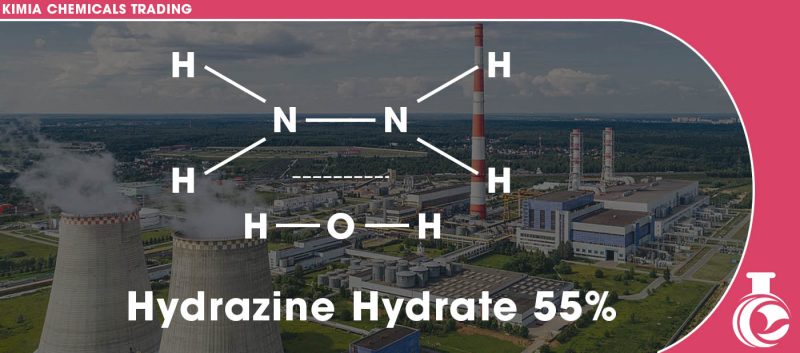
Hydrazine hydrate 55 is a mineral chemical compound. This substance is a colorless and flammable liquid with an odor similar to ammonia. Hydrazine hydrate is highly toxic and is a reactive and responsive base. This compound reacts strongly with oxidizers, acids, metals, and metal oxides. Hydrazine hydrate has a density of 1.1 grams per cubic centimeter, a melting point of 2 degrees Celsius, and a boiling point of 114 degrees Celsius.
Applications of Hydrazine Hydrate 55:
Initially, derivatives of hydrazine hydrate 55 were used in the production of fungicides and herbicides. However, over time, these substances found their way into the pharmaceutical industry and are now used in the production of various drugs, including tranquilizers.
Hydrazine and its derivatives in water boilers are used as oxygen scavengers. Solutions containing 35% hydrazine have the ability to reduce oxidation in high and low-pressure steam systems. In fact, hydrazine hydrate 55 is one of the best substances used to prevent oxidation in critical boiler operations, even at higher pressures.
Currently, the plastics manufacturing industry uses derivatives of hydrazine to produce polymers. The use of these derivatives in the production of various polymers continues to be part of various industries.
In summary, the applications of hydrazine hydrate 55 include:
- Water and wastewater treatment
- Alloying and soldering
- Jet fuel and rocket propellants
- Photography, textile, and fiber industries
- Boiler cleaning
- Pharmaceutical industry
- Blowing agent in polymer foams such as Eva, Pe, Pvc, PMMA, etc.
Chemical Specifications of Hydrazine Hydrate 55 (N2H4):
| English Name | Hydrazine hydrate |
| Molecular Formula | N2H4 or H2N-NH2 or H2NNH2 or H4N2 |
| Molecular Weight | 32.046 g/mol |
| Density | 1.01 g/mL |
| Solubility in Water | Soluble in polar organic solvents |
| Melting Point | 275°C |
| Boiling Point | 387°C |
| Viscosity | 0.32 cP at 20°C |
Behavior of Hydrazine Hydrate:
Hydrazine hydrate 55 is used as a simple solvent or as a catalytic substance. It can be used in the gold refining process (aqua regia). In most cases, hydrazine is converted to hydrazine hydrate by combining it with water.
Anhydrous hydrazine, used as rocket fuel, is an important mineral compound obtained by removing water from hydrazine hydrate. The use of anhydrous hydrazine in Europe is much less compared to hydrazine hydrate.
In recent years, the global demand for hydrazine hydrate 55 has been around 80,000 to 90,000 tons per year, with expectations of continuous growth, but the demand for this product has decreased in advanced countries. However, demand in developing countries, especially growing Asian countries, has been on the rise.
The UK Health and Safety Executive uses hydrazine hydrate as an oxygen scavenger in the steam boiler systems of power plants.
Storage of Hydrazine Hydrate 55:
To prevent hazards such as ignition, hydrazine hydrate should be stored in a closed environment with warning electrical equipment. Hydrazine should never be used near flames, sparks, or similar sources. Smoking should never be allowed in areas where hydrazine is used.
Additionally, contact with direct sunlight and metals, as well as chemical compounds like oxides, should be avoided. In case of a hydrazine hydrate leak, containers containing it should be washed with cool water, and further entry of this substance into the environment should be prevented.
In case of hydrazine ignition, immediate extinguishing of the fire should be undertaken. Firefighters should be equipped with respiratory masks and full safety gear.
For extinguishing small fires, water, cool chemicals, or CO2 gas is used. In the case of large fires, alcohol or high-pressure water should be used. Hydrazine hydrate should be stored in tight barrels in a neutral environment. The storage area for these barrels should have proper ventilation, suitable drainage, and be away from direct sunlight and other energy sources.
It is also necessary to avoid the presence of metals, metal oxides, and flammable materials in this storage area, and to prevent electrical sparks, storage tanks for hydrazine should be grounded.
According to international regulations, hydrazine hydrate 55 should be transported in metal tanks with an inner coating of polyethylene, plastic containers, or stainless steel tanks.
For ordering hydrazine hydrate 55 or obtaining more information about this product, contact our experts at Kimia Chemicals Trading Co.
Frequently Asked Questions:
- What effects does hydrazine have on the human body?
Exposure to hydrazine can cause skin burns, contact dermatitis, burning and inflammation of the eyes, nose, and throat, experience of nausea or vomiting, shortness of breath, lung swelling, headaches, dizziness, central nervous system depression, weakness, temporary vision blur, seizures, and fainting.
- Is hydrazine carcinogenic?
According to scientific research results, hydrazine is recognized as a carcinogenic substance for humans. Long-term use of toxic doses of hydrazine can increase the risk of developing cancer, and therefore, the classification of hydrazine as an active carcinogenic substance remains.
- Why is hydrazine unstable?
Hydrazine is a highly toxic and dangerous liquid, and because of its instability, it poses greater risks. Hydrazine has an ammonia-like odor, and this instability is likely due to the formation of two ammonia molecules.
